


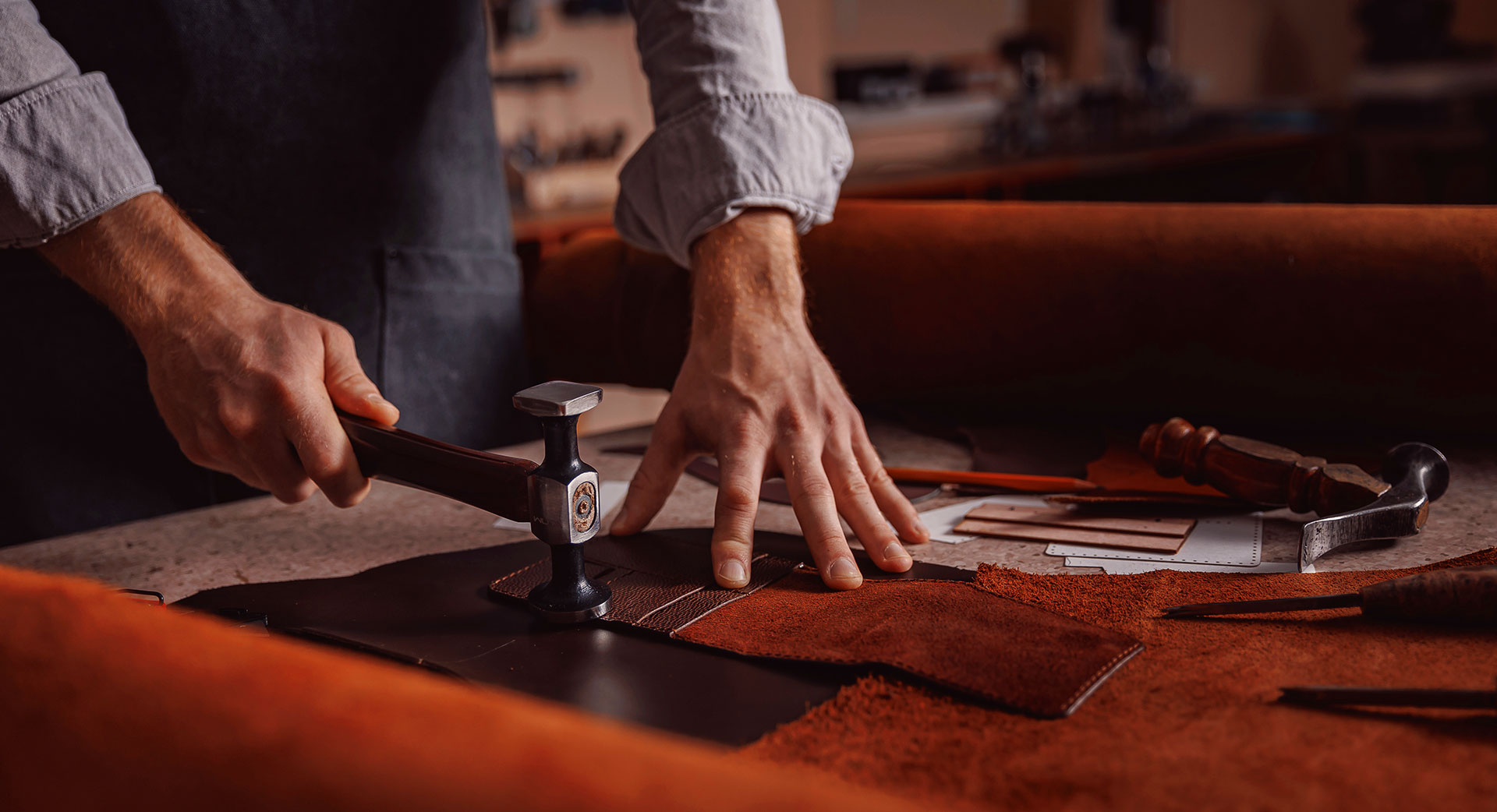
26 Apr Essential Leather Tools for Beginners and Experts Alike
Some tools grow with you. You pick them up as a newcomer, slightly uncertain how to use them, and years later, they’re still in your kit, performing the same quiet function they always did. No upgrade needed. No replacement in sight.
These are the tools worth knowing about early.
The Cutting Knife: Where Everything Starts
No tool sees more use in leatherwork than a good cutting knife. Patterns get traced, straps get cut, skiving begins here. And yet beginners often underinvest in this one, treating it as a commodity while overspending on specialized items they rarely reach for.
A quality round knife or head knife gives you versatility across virtually every cutting task. It curves where curves help, straightens where lines demand it, and with proper sharpening, handles material from thin garment hide to thick harness leather without swapping out.
Experts reach for theirs instinctively. Beginners who start with a good one skip years of frustration.
Punches: The Tool Family You’ll Keep Expanding
You probably need more punch sizes than you think, and fewer punch types than you might buy impulsively. The core set for most leatherworkers covers:
- Small tube punches for lace holes and fine stitching applications
- Medium sizes for standard strap and belt hardware
- Larger diameters for decorative work and specific fastener types
A revolving punch handles daily convenience. Single-tube drive punches give you cleaner results when precision visually matters. Both have legitimate places in a kit, regardless of your experience level.
The Skiver and Splitter: Underappreciated Workhorses
Beginning leatherworkers often skip these. Experienced ones consider them indispensable. The skiving knife thins leather at edges and joins, allowing seams that lie flat and finished edges that bevel without bulk. Without it, certain construction methods simply don’t work cleanly.
A leather splitter takes this further, reducing overall thickness across larger sections for projects requiring consistency throughout. Bags, wallets, and any layered construction benefit from stock that’s been split to a uniform gauge rather than relying on inconsistent hide thickness off the roll.
These tools reward patience. They take some practice to use confidently. But every leatherworker who commits to learning them reports a visible step change in finished quality.
Edge Tools: The Finishing Layer
The difference between a piece that looks handmade and one that looks hand-crafted often lives entirely in the edge treatment. Raw, unfinished edges announce themselves immediately. Beveled, burnished, and sealed edges signal something different.
Edge bevelers remove the sharp corner left by cutting. Bone folders and wooden slickers compress and polish the edge fiber when used with gum tragacanth or tokonole. This sequence takes a few minutes per project and transforms the perceived quality of the finished piece dramatically.
Beginners who learn edge finishing early develop a standard they carry forward. Experts who skip it are, frankly, rare.
Stitching Tools: Consistency Over Speed
Stitching chisels or pricking irons space your holes evenly and at consistent angles. The results read as professional regardless of whether the stitching is done by hand or machine. Uneven spacing, by contrast, draws the eye even on otherwise excellent work.
A good stitching groover paired with a quality pricking iron gives both beginner and expert the same foundation: holes that are evenly placed, consistently angled, and ready for thread that will hold. The tools that serve everyone across every skill level share one quality. They don’t impose a ceiling. They simply perform, every time, until the work is done.